Pay transparency
The pay transparency law is coming. Is your company ready?
EU Directive 2023/970 changes hiring, pay management and reporting at every company, from micro to large. Portugal is transposing it. Selfcare was designed so that compliance is a by-product of having your data in the right place.
What changes, and when
- TodayLei 60/2018 (Law 60/2018) already applies: the ACT (labour inspectorate) can notify your company to present a plan assessing pay differences within 120 days. Unjustified differences are presumed discriminatory.
- With the Portuguese law (transposition under way)A pay range before the interview, and a ban on asking about pay history. A reply within 2 months to any employee who asks for average pay by gender in their category. An end to pay secrecy clauses. It applies to ALL companies, with no minimum size.
- 7 June 2027First public gender pay gap report for companies with 150 or more workers (after that, every 3 years; yearly for 250+).
- 7 June 2031First report for companies with 100 to 149 workers.
- Whenever there is a reportAn average gap of 5% or more in a category, with no objective justification, gives you 6 months to correct it. If that fails, a joint pay assessment with workers' representatives follows.
Portugal missed the transposition deadline (7 June 2026). The rules are part of the labour reform package. The report dates come from the directive itself and don't change with the Portuguese delay.
How Selfcare prepares you, starting today
The raw material of pay transparency is structured pay data. That is exactly what Selfcare keeps from day one.
- Structured job roles. Create, merge and organise the company's roles. Each employee is linked to theirs. This is the basis of the “work of equal value” categories the directive requires.
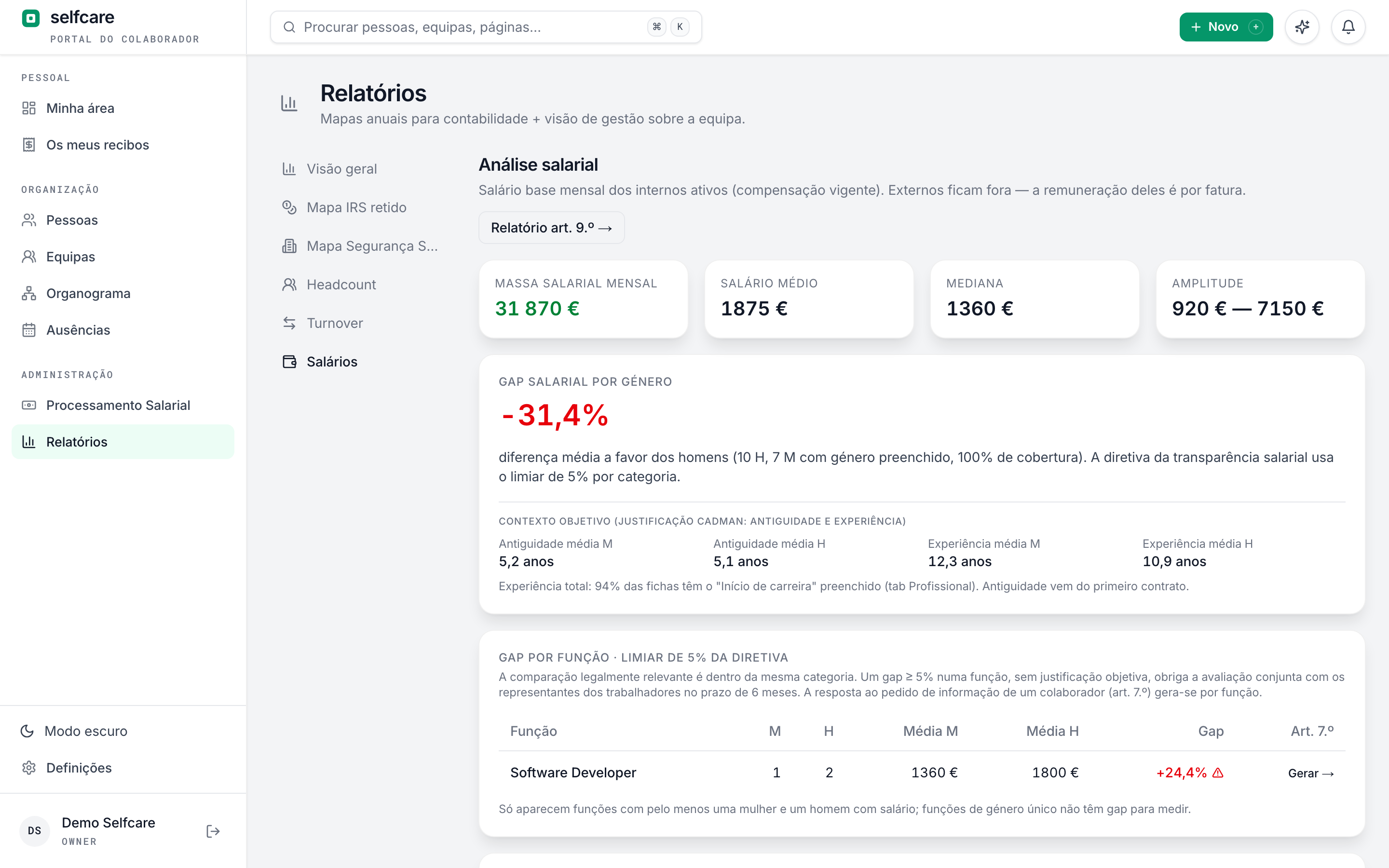
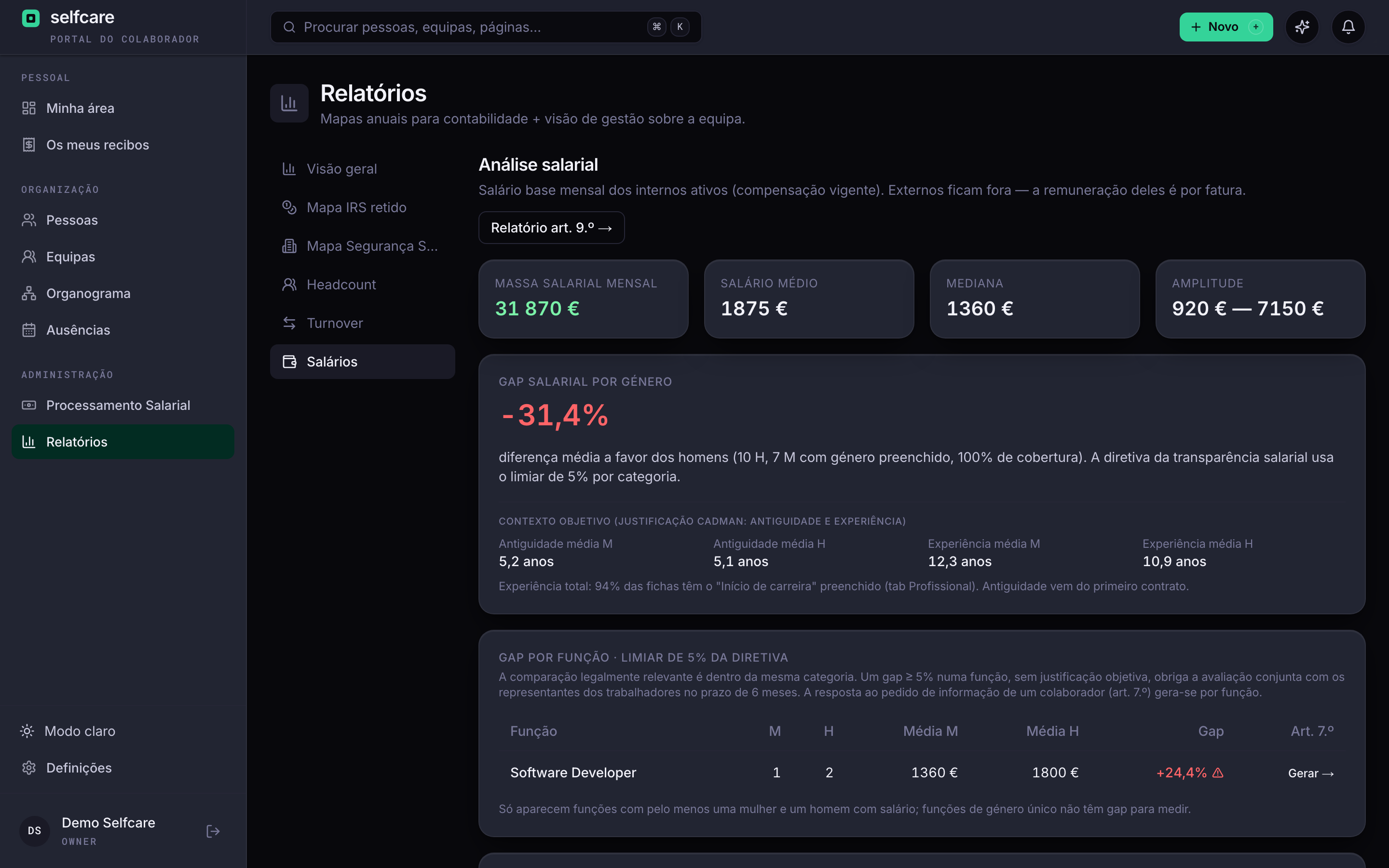
- Gap by role with the 5% threshold. The report compares the averages of women and men within each role, exactly the comparison the law asks for, and flags in red the roles above the threshold.
- Reply to Article 7 in one click. When an employee asks for the pay levels of their category (they have that right, with a 2-month reply deadline), you generate the document ready to hand over.
- Full Article 9 report. Mean and median gap, complementary components, proportion by quartile and gap by category, ready to print.
- Objective context included. Average seniority and experience by gender next to the gap: with the burden of proof reversed, documented justification is your defence.
Not on Selfcare yet? Measure your company now with the free pay gap calculator, with no sign-up and no data sent.
Measure first and you fix it in private. Measure late and you fix it in public.
Frequently asked questions
My company has fewer than 100 employees. Does this apply to me?+
Yes, for the most part. The public gap report is only mandatory from 100 workers. But transparency in hiring (pay range, ban on asking about history), employees' right to information, objective pay criteria and the end of pay secrecy apply to all companies. And Lei 60/2018 already lets the ACT call to account companies with more than 50 workers.
What is the 5% threshold?+
Suppose the report shows an average difference of 5% or more between women and men in a category of equal work or work of equal value. If the company neither justifies it with objective criteria nor corrects it within 6 months, it must carry out a joint pay assessment with workers' representatives. Public and uncomfortable. The best strategy is to measure before it becomes mandatory.
What data do I need in order?+
Complete salaries (base and variable components), job roles structured into comparable categories, gender, and documented progression criteria. In Selfcare, the first three are already product fields. And because the analysis reads payroll, the amounts used are the ones actually paid.
Portugal hasn't transposed it yet. Why prepare now?+
Because the report dates (2027 and 2031) come from the directive and don't change with the delay. Because Lei 60/2018 is already in force. And because fixing a pay gap takes time and budget. Measure first and you fix it in private. Measure late and you fix it in public.
Measure your gap before it becomes mandatory
In a 30-minute demo we import your data and show your company's salary analysis, by role and by gender, as it stands today.